2 November 2026
What Is Bent Glass? How Curved Glass Is Made
Bent glass — also called curved glass — is ordinary flat glass that has been reshaped into a curve. Instead of a single flat plane, the finished panel follows a radius, a cylinder, or a more complex double-curved form. It lets architects and designers wrap glazing around corners, towers, canopies and furniture without breaking the surface into faceted flat panels.
Curved glass is used anywhere a smooth, continuous glass surface is wanted: building façades and entrances, balustrades and staircases, skylights and canopies, lift (elevator) enclosures, shopfronts, aquariums, and high-end furniture.
How bent glass is made
There are two main ways to curve glass, and the right one depends on the radius, the glass build-up and whether the glass must also be heat-treated.
1. Hot bending (the most common method)
In hot bending, the flat glass is laid over or into a steel mould shaped to the target curve and heated in a bending furnace to around 600–650 °C. As the glass softens it sags under its own weight (gravity bending) or is pressed to take the exact shape of the mould. It is then cooled in a controlled way.
Hot bending can produce:
- Single-curved glass — a simple cylindrical curve, bent on one axis (the most common curved glass).
- Double-curved or multi-curved glass — curved on more than one axis (spherical or free-form shapes), which needs more sophisticated moulds and furnaces.
How the glass is cooled after bending decides its strength:
- Annealed curved glass cools slowly and stays relatively weak, like ordinary float glass.
- Toughened (tempered) curved glass is rapidly quenched after bending, so it is up to five times stronger and breaks safely — the curved equivalent of flat toughened glass.
2. Cold bending
For very large radii (a gentle curve), the glass can be bent cold — mechanically forced into a slight curve during installation and held there by the frame or by lamination, without heating. Cold bending is limited to shallow curves but avoids the optical distortion that heating can introduce.
Curved laminated and insulated glass
Curved glass is rarely used as a single bare pane on a building. It is usually built up for safety and performance:
- Curved laminated glass bonds two or more curved panes with an interlayer, so broken fragments stay in place — essential for overhead glazing, balustrades and anywhere fall-through must be prevented.
- Curved insulated glass units (IGUs) seal two curved panes around a spacer for thermal insulation on façades and skylights.
Because both panes must share exactly the same curve, curved laminated and insulated units demand tight manufacturing tolerances.
How to measure and dimension bent glass
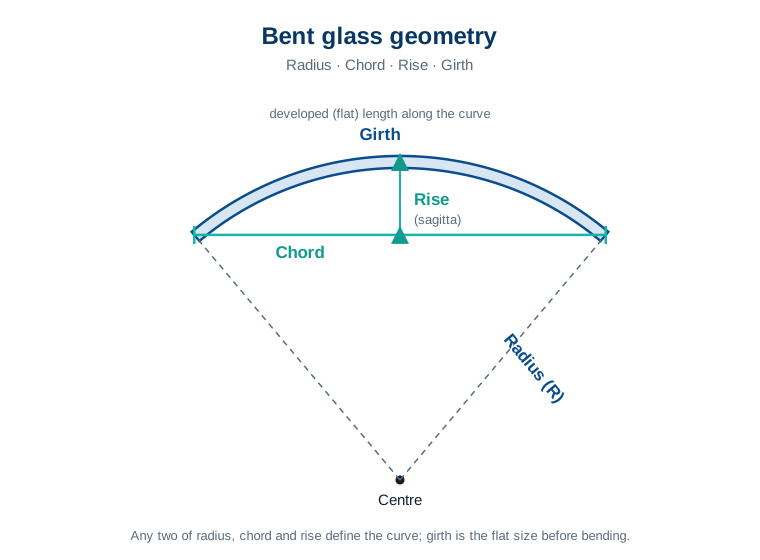
Curved glass is dimensioned by its geometry, not just by width and height. Four measurements describe a simple (single-axis) curve, and they are all linked — so supplying any two of them, plus the panel height, lets the maker derive the rest:
- Radius (R) — the radius of the circle the curve follows. A smaller radius means a tighter, deeper curve; a larger radius is a gentler bend.
- Chord — the straight-line distance between the two ends of the arc. On a façade this is usually the opening width the glass has to span.
- Rise (sagitta) — the depth of the curve: the perpendicular distance from the midpoint of the chord to the arc. It tells you how far the glass bulges out from a flat line across the opening.
- Girth (developed or arc length) — the length measured along the curved surface. This is the size of the flat glass before it is bent, so it drives the sheet size and nesting.
For a circular arc these relate by simple geometry — for example the chord ≈ 2 × √(2R·rise − rise²), and the girth = R × θ, where the included angle θ (in radians) = 2 × arcsin(chord ÷ 2R). The girth is always longer than the chord. In practice, give us the radius plus chord (or chord plus rise) and the panel height, and the developed flat size follows — or simply send a drawing and we work back to the geometry. These relationships are universal to curved glass and do not depend on any particular product.
Key things to specify for bent glass
When you order curved glass, confirm the following so the panel fits the first time:
- Radius and geometry — the inside or outside radius, the arc length, and whether the curve is single- or multi-axis. Supply a drawing where possible.
- Glass thickness — thicker glass resists the bend better and carries more load, but a tighter radius limits how thick you can go.
- Heat treatment — state whether you need annealed, heat-strengthened or toughened curved glass for the safety and strength the application requires.
- Build-up — monolithic, laminated (for safety), or an insulated unit for thermal performance.
- Tolerance — curved glass has shape tolerances; agree them up front, especially for laminated or insulated units where two panes must match.
- Orientation and marking — mark which way the panel curves and which edge is up, so it is installed the right way round.
What we can produce
Once the geometry is clear, the panel has to sit inside what can actually be manufactured. The ranges below come from our single- and multi-curved product pages:
| Type | Thickness | Radius | Max size | Shape |
|---|---|---|---|---|
| Single-curved | 5–25 mm | from about 420 mm (process-dependent) | soft-axis arc length up to 2440 × height 5000 mm | Cylindrical (one axis) |
| Multi-curved | 5–19 mm | Project-specific | Project-specific — send drawings | Spherical, conical, barrel, free-form |
Single-curved glass is produced to GB 15763.1, EN 12150 and ASTM C1048; multi-curved glass is produced to GB 15763.1 and EN ISO 12543. Both can be toughened or heat-strengthened and built up as laminated or insulated units.
Common issues with bent glass
A few issues come up often enough on curved projects that they are worth designing out from the start:
- Optical distortion — heating glass to bend it can introduce slight reflected-image distortion, which is more noticeable on a curved surface than on a flat one. Cold bending avoids heat-induced distortion but is limited to shallow curves.
- Matching two panes — laminated and insulated units need both panes bent to exactly the same curve. If the curves do not match, the panes will not bond or seal cleanly, so pairing matters as much as the curve itself.
- Coating before bending — a Low-E or other coating is applied to flat glass and then bent; it cannot be added after the glass is curved. The coating and build-up therefore have to be decided before the glass goes into the bending furnace.
- Handling, transport and installation — curved panels are more vulnerable at the edges and awkward to support, so they need shaped crates and careful site handling to reach the opening undamaged.
Getting the right curved glass for your project
Bent glass combines the geometry of the curve with the strength, safety and thermal requirements of the application — it is not simply “flat glass, curved.” If you share the radius, size, thickness and the standard you build to, we can advise on the right specification and supply curved glass to match.
Browse our single-curved glass and multi-curved glass ranges, or get a quote to start.
Frequently asked questions
What is the difference between single-curved and multi-curved glass? Single-curved glass is bent to one radius on a single axis — a simple cylindrical curve, the most common type. Multi-curved glass is bent on two or more axes for spherical, conical or free-form shapes. See our curved glass manufacturer overview for how each is made and used.
Can curved glass be toughened and laminated? Yes. Curved glass can be toughened (tempered) after bending for strength and safety, and curved panes can be laminated together with an interlayer or sealed into an insulated unit — the same build-ups as flat glass, just following the curve.
How do I measure a curved panel for a quote? Give the radius plus the chord (or the chord plus the rise), together with the panel height — or send a drawing. From any two of the curve measurements we can work out the developed flat size and confirm what is feasible.
What is the largest curved panel you can make? Single-curved glass runs up to a soft-axis arc length of 2440 × height 5000 mm; multi-curved sizes are project-specific, so send drawings. For real-world examples, see our curved glass railway-station façade case and curved glass research-institute façade case.
Related reading
Interested in our glass products?
Contact our export team for technical advice, samples and a competitive quotation.
Get a Quote